
The battle for the top spot in the two-wheeler market is intensifying. The gap between Hero MotoCorp and Honda Motorcycle & Scooter India (HMSI) in retail sales narrowed to just 45,607 units in June. This improvement comes as HMSI has clawed back market share after dipping to a historic low of 18 per cent in May 2023. Now, the retail market shares of the two companies are 28.86 per cent and 25.54 per cent, respectively, compared to 35.54 per cent and 18.05 per cent in May 2023.

Tata Motors, Mahindra & Mahindra and Kia India on the other hand witnessed an increase in their market share based on the retail sales last fiscal. As per the Federation of Automobile Dealers Associations (FADA), the retail sales of country's largest carmaker Maruti Suzuki India rose to 14,79,221 units in 2022-23 fiscal, attaining a market share of 40.86 per cent. It had retailed 12,39,688 units in 2021-22 and grabbed a market share of 42.13 per cent.

'Nearly all companies are extending festival offers for entry-level, sedan, and hatchback segments.'

Consumer goods firms and auto companies are witnessing an upturn in rural demand, which had been lagging for most of FY24. Expectations of a bumper rabi crop harvest have helped turn the tide. The Reserve Bank of India's (RBI's) Monetary Policy Committee kept the repo rate unchanged last week, noting that as rural demand catches up, consumption is expected to support economic growth in 2024-25.

The Federation of Automobile Dealers Association of India will soon launch a program for checking cars which are more than three years old across the country for Rs 500, liable to be reimbursed while going for insurance, a top official said on Thursday.

Automobile retail sales in India rose 11 per cent in September as better supplies from manufacturers enabled dealers to ramp up customer deliveries amid the ongoing festive period, Federation Of Automobile Dealers Associations said on Tuesday. Last month, total retail sales stood at 14,64,001 units as compared to 13,19,647 units in September 2021. FADA noted that October is expected to witness even better overall sales due to the festive season further gathering steam.
Retail sales of overall vehicles in India grew by 15.28 per cent to 2,11,20,441 units in 2022 led by record sales of passenger vehicles and tractors, Federation of Automobile Dealers Associations (FADA) said on Thursday. In 2021, total retail sales of vehicles in India were at 1,83,21,760 units, FADA said in a statement. Two-wheelers retail sales stood at 1,53,88,062 units last year, a growth of 13.37 per cent from 2021 when sales stood at 1,35,73,682 units.
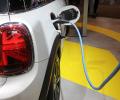
Electric vehicle retail sales in the country witnessed over three-fold jump last fiscal with two-wheeler offtake leading the segment, according to data compiled by automobile dealers' body FADA. Total electric vehicle (EV) retails reached 4,29,217 units in 2021-22, a rise of three-fold from 1,34,821 units in the financial year 2020-21, the industry body said. Total EV sales had stood at 1,68,300 units in the 2019-20 fiscal, it noted.

The two-wheeler segment is, however, still far from its H1FY19 peak of 9.7 million units
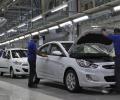
Passenger vehicle retail sales in the country rose 40 per cent in June indicating an improvement in semiconductor supplies even as demand, especially for SUVs, remained robust, auto dealer' body FADA said on Tuesday. According to the Federation of Automobile Dealers Associations (FADA), passenger vehicle (PV) registrations rose to 2,60,683 units last month, as compared to 1,85,998 units in June 2021, registering an increase of 40 per cent. "The PV segment continued to see robust growth. An increase in dispatches clearly shows that semiconductor availability is now getting easier," FADA president Vinkesh Gulati said in a statement.

Automotive (auto) and auto ancillary stocks have been in the fast lane thus far in 2023-24 (FY24), with the National Stock Exchange Nifty Auto Index surging nearly 27 per cent, outperforming the Nifty50, which has gained roughly 11 per cent during this period. The top-gear performance of auto stocks at the bourses, according to A K Prabhakar, head of research at IDBI Capital, has been triggered by the premiumisation of products across vehicle manufacturers, which has seen vehicle sales remaining relatively stable. "It is not about higher sales figures now, but about premiumisation.
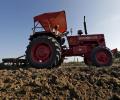
After a stellar run on the bourses that saw tractor stocks rise up to 52 per cent, analysts are turning cautious on the sector as muted demand trends may weigh in the near-term. Total volumes in the tractor segment for the last three quarters of the current financial year (9MFY24) have remained weak with VST Tillers, Escorts Kubota, and M&M seeing declines of 21 per cent, 5 per cent, and 3 per cent year-on-year (Y-o-Y), respectively, during the period, amid patchy rainfall, delayed crop harvest, and lower reservoir level. Across industry, total domestic sales volume so far in the current financial year (April '23 to January '24) has declined 5 per cent Y-o-Y, as per Tractor Manufacturers Association (TMA).
Passenger vehicle retail sales in India witnessed an 11 per cent year-on-year decline in December as semiconductor shortage continued to impact the segment, automobile dealers' body FADA said on Wednesday. The passenger vehicle (PV) retail sales last month fell 10.91 per cent to 2,44,639 units from 2,74,605 units in December 2020. "The month of December is usually seen as a high sales month where OEMs continue to offer best discounts to clear the inventory due to change of the year.
Automotive retail sales saw a 14 per cent rise in March on a year-on-year (YoY) basis, according to data released by the Federation of Automobile Dealers Associations (FADA). For the whole of financial year 2022-23 (FY23), sales grew 21 per cent YoY. For both March and the financial year, all categories, except for tractors, and including two-wheelers, three-wheelers, passenger vehicles (PVs), and commercial vehicles (CVs), posted double-digit growth. However, the total retail sales of 22.1 million for the financial year were still 12 per cent lower than the pre-Covid (FY20) level of 25 million, owing to an 18 per cent dip in the two-wheeler segment.
Aided by robust festive season offtake, automobile retail sales in India witnessed a 48 per cent annual jump in October, automotive dealers' body Federation of Automobile Dealers Associations said on Monday. The total retail sales last month stood at 20,94,378 units, up 48 per cent from 14,18,726 registrations in October 2021. The registrations last month were even better by 8 per cent as against October 2019, a pre-COVID month. The festive season this year turned out to be the best for the industry in the last four years.
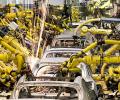
286 dealers closed down in 18 months, 32,000 jobs impacted. Maharashtra leads with 84 closures, followed by Tamil Nadu and Delhi. The worst-hit is the passenger car segment.

'From data on enquiries, we can build what we call a data lake or a data warehouse where data is classified into various cohorts and then we use AI and ML tools to predict demand down the line.'

Besides job loss, the exit of the American cult bike maker would also lead to a loss of up to Rs 130 crore for the brand's dealer partners in the country.
Automobile retail sales in India increased by 37 per cent in April on a low base of COVID-hit April last year, automobile dealers' body FADA said on Thursday. Total sales across categories rose to 16,27,975 units in April, as compared to 11,87,771 units in the year-ago period. On a year-on-year basis, all vehicle categories including passenger vehicles and two-wheelers were up as compared with April last year.

While commercial vehicle (CV) sales were the worst hit, down by 21 per cent to 67,793 units from 85,833 units, two-wheeler sales dropped by 16 per cent to 12,64,169 units from 15,00,545 units. Passenger car sales dropped nine per cent to 215,716 units from 236,586 units.

Mahindra & Mahindra chairman emeritus Keshub Mahindra passed away this morning in Mumbai due to old age. Mahindra, 99, breathed his last this morning at home peacefully, said a person close to the family. After joining the company in 1947, he became the chairman in 1963.
Automobile dealers' body FADA on Thursday said passenger vehicle (PV) retail sales in March witnessed a year-on-year growth of 28.39 per cent to 279,745 units, as compared to the year-ago period which saw disruptions in the market due to COVID-19 led lockdown. According to the Federation of Automobile Dealers Associations (FADA), which collected vehicle registration data from 1,277 out of the 1,482 regional transport offices (RTOs), PV sales stood at 217,879 units in March 2020. Two-wheeler sales, however, declined 35.26 per cent to 11,95,445 units last month, as compared to 18,46,613 units in March 2020. Commercial vehicle sales also declined 42.2 per cent to 67,372 units, as against 116,559 units a year ago.
Dealers say that the full-year outlook remains negative with a projected contraction in retail sales of 15-35 per cent across segments, save tractors, which look set to clock a positive annual growth.

Retail sales of passenger vehicles - the largest component of the pie - jumped 11 per cent year-on-year in October to 248,036 units, largely because of discounts offered during Navratri and Diwali.
Honda Motorcycle and Scooter India (HMSI), the country's second-largest two-wheeler manufacturer, is planning to launch its first electric vehicle (EV) here by March next year, said CEO & MD Atsushi Ogata on Monday. The company would also enter the low-end motorcycle market in March by launching a 100cc engine bike at a price that will "positively shock" customers, he said while speaking with reporters, after launching the Activa with Honda Smart Key. HMSI's first EV, an electric scooter, will have a fixed battery and the second model will have two swappable batteries, Ogata explained.

PV registrations in this year's festive period stood at 287,717 units as against 333,456 units in the corresponding period last year, down 14 per cent. Two-wheeler registrations also fell by 13 per cent to 15,83,276 units as against 18,11,703 units in the year-ago period.

As per the conditions set by General Motors, a dealer who does not accept its offer by July 15 would get only 50 per cent of the compensation amount being offered.

Dealers say the significant increase in sales was driven by a need to plug the diminishing inventory as most dealerships were transitioning from BS-IV to BS-VI when the Covid-19 lockdown was announced.

At the end of May, out of 26,500 outlets about 60 per cent showrooms and 80 per cent workshops were operational across the country.

Passenger vehicle wholesale in India increased by 14.19 per cent to 3,10,294 units in October against 2,71,737 units in the same month last year as companies despatched more units to dealers to cater to enhanced demand in the festive season, auto industry body SIAM said on Wednesday. According to the latest data by the Society of Indian Automobile Manufacturers (SIAM), two-wheeler sales also rose 16.88 per cent to 20,53,814 units, compared with 17,57,180 units in the same month last year. Motorcycle sales were at 13,82,749 units as against 11,16,886 units in October 2019, up 23.8 per cent.

At Prestige Polygon Towers in Chennai's Teynampet, hectic preparations are on for a mega global investors' meet under the aegis of Guidance Tamil Nadu (the state investment promotion agency) scheduled for January 2024. Asked about the key focus areas of the meet, the agency's managing director and chief executive officer, V Vishnu, said the state was betting big on electric mobility. This is no surprise, given that the state has signed electric vehicle (EV)-related memorandums of understanding (MoUs) with several companies in the recent past that may bring in investments worth around Rs 33,000 crore with the potential to create over 43,000 job opportunities.

Automobile dealers' body FADA said the Budget lacked immediate demand boosters for the automobile industry.

However, the World Bank has projected India's GDP growth rate at 7.5 per cent for the next three financial years, including the current one.
Indian consumers are likely to get respite from rising prices just before the festival season. Some consumer companies, including automakers, have indicated that they are planning to pause price hikes just before demand picks up in August, while keeping a close eye on volatile raw material prices.
After a very weak December quarter and a poor year-to-date fiscal year volumes-when sales plunged to the lowest in nine years, the signs in the first 15 days of January haven't been encouraging either. "Though the severity of the current wave is not as high as the previous one, it has hit the sentiments hard impacting conversion of enquiries into sales," said Vinkesh Gulati, president, Federation of Automobile Dealers Association (FADA).

Lenders have become worried as some dealers were not using the money provided to them for car financing.
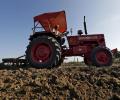
This rise was spurred by record kharif sowing - after a good rabi season - that ensured high disposable incomes in rural India.

Recently, South Korean Foreign Minister, Chung Eui-yong, dialled his Indian counterpart, S Jaishankar, in New Delhi. His government, he said, "regretted the offence caused to the people of India". A day earlier, India had summoned the South Korean ambassador to express its "strong displeasure" over "an unacceptable social media post".

As macroeconomic numbers continue to disappoint, reaching pre-Covid level is unlikely in FY21.

Renault will start with a slew of new products that will be launched over the second half of this year and next year, apart from giving facelifts to the Kwid and Duster.
 © 2026 Rediff.com - Advertise with us - Disclaimer - Privacy Policy - Sitemap - Feedback - About us - Terms of use - Grievances